
Butcher’s Crossing (2022)
November 16, 2025
“Butcher’s Crossing” (2022) is the kind of western that quietly sharpens a knife behind its back. On the surface, it’s a simple frontier story: a young Harvard dropout named Will Andrews heads west in the 1870s, chasing some romantic vision of “real life” in the American wilderness. What he finds instead is a brutal crash course in obsession, greed, and the emptiness at the heart of the frontier myth. The film takes its time at the beginning, letting you settle into the dusty rhythms of the small town of Butcher’s Crossing, only to slowly twist that sense of adventure into something suffocating and nightmarish.

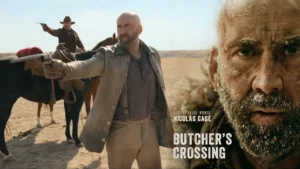
At the center of that nightmare is Miller, played with unnerving intensity by Nicolas Cage. Bald, bearded, and radiating a quiet menace, he’s a buffalo hunter who claims to know of a hidden valley overflowing with untouched herds. Miller isn’t just a man with a plan; he’s a zealot. The expedition he leads—with naive Will, world-weary skinner Fred, and nervous cook Charley in tow—has the structure of a religious pilgrimage and the madness of a suicide mission. Watching Cage’s Miller, you never quite know whether you’re seeing a visionary, a madman, or the inevitable product of a system that rewards killing and calls it progress.

Once the party reaches the valley, the film shifts gears into something hypnotic and increasingly disturbing. At first, the high plains are breathtaking—vast skies, golden grass, and herds of buffalo moving like a dark river across the land. But the beauty curdles as the hunt begins. The sound of the rifle becomes a metronome of death, and the film lingers on the repetition: kill, skin, stack, repeat. There’s a dull, numbing rhythm to the slaughter that mirrors Miller’s monomania. What started as an adventure gradually feels like a ritual of annihilation, and the film makes you complicit by refusing to look away.

Will’s transformation is one of the film’s quiet triumphs. He arrives in Butcher’s Crossing soft-spoken, idealistic, almost fragile—a boy who has read too many books about “finding oneself” in nature. As the journey wears on, you see the awe in his eyes sour into horror and then harden into a distant, almost numb stare. He’s fascinated and repulsed at the same time: drawn to Miller’s certainty yet horrified by the cost of that conviction. The real violence of the film isn’t just in the gunshots; it’s in watching Will’s illusions about the West, about work, about manhood and meaning, get skinned and left out to dry like buffalo hides.

What elevates “Butcher’s Crossing” beyond a simple anti-western is how clearly it links this small, grim expedition to larger ideas—capitalism, environmental ruin, and the myths people build to justify their worst impulses. The men keep telling themselves that this is a once-in-a-lifetime opportunity, that they’ll get rich, that no one has ever seen a valley like this and they’d be fools not to take everything they can. But the more they kill, the less sense any of it makes. The piles of hides start to look less like wealth and more like an accusation, and the valley—stripped and silent—feels like a graveyard they dug with their own hands.

By the time the story circles back to town, the film has completely inverted the classic frontier fantasy. There’s no heroic ride into the sunset, no triumphant homecoming, just the bitter taste of consequences. The West here is not a place where a man “finds himself,” but a place where he discovers how far he’s willing to go for an idea that might not have meant anything in the first place. “Butcher’s Crossing” leaves you with images that are hard to shake: the smoking rifle barrels, the mountains of hides, the empty, echoing valley, and the haunted looks on the men’s faces as they realize that some lines, once crossed, can never be uncrossed.
https://www.youtube.com/watch?v=Kb9K63W4zPU