
Nuremberg (2026)
January 31, 2026
“Nuremberg (2026)” is a gripping, intellectually charged historical drama that feels less like a period film and more like a mirror held up to the modern world. From its opening moments, the film establishes a heavy, unsettling atmosphere, dropping the audience into post–World War II Europe where the rubble of war is not just physical, but moral. The city of Nuremberg stands as a symbol of both atrocity and accountability, and the film immediately makes it clear that this story is not about easy justice or heroic triumphs. Instead, it is about the slow, painful process of forcing truth into the open, even when that truth threatens to destabilize those who seek it.

The narrative centers on the preparation and execution of the Nuremberg Trials, but what makes the film so absorbing is its focus on the people behind the proceedings rather than the history books. Judges, prosecutors, translators, journalists, and even guards are portrayed as deeply human, each wrestling with their own doubts, trauma, and sense of responsibility. The film carefully explores the psychological weight of listening to testimonies describing unimaginable crimes day after day, and how justice begins to feel fragile when confronted with the sheer scale of human cruelty. Dialogue-driven scenes crackle with tension, turning courtroom exchanges into battles of ideology, memory, and moral survival.

What truly elevates “Nuremberg” is its refusal to simplify guilt or innocence into clean categories. The accused are not depicted as cartoon villains, but as chillingly ordinary men who hide behind bureaucracy, obedience, and legal technicalities. This approach makes their crimes feel even more disturbing, forcing the audience to confront how easily evil can be normalized when power and fear intertwine. At the same time, the film challenges the prosecutors themselves, questioning whether justice delivered by the victors can ever be free of political compromise. These moral gray zones give the film its emotional depth and make every verdict feel heavy rather than triumphant.

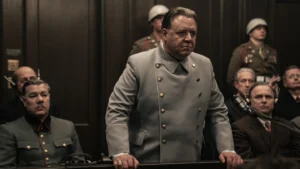
Visually, the film is restrained yet powerful, using muted colors, cold lighting, and claustrophobic interiors to emphasize the suffocating weight of history pressing down on every character. The courtroom becomes a character in its own right, a space where silence can be louder than testimony and where a single sentence can shatter years of denial. Outside, the devastated streets of Germany serve as a constant reminder that the consequences of ideology are not theoretical, but etched into buildings, families, and futures. The cinematography avoids spectacle, choosing stillness and patience to let the gravity of events speak for itself.

At its core, “Nuremberg (2026)” is not only about punishing the past, but about warning the future. The film repeatedly asks uncomfortable questions about collective responsibility, the limits of law, and the danger of forgetting. Characters grapple with whether justice can truly heal a world so deeply wounded, or whether it merely draws a line in history and hopes humanity learns from it. The emotional power of the film lies in these quiet moments of reflection, where characters realize that the trials are not just judging the defendants, but humanity itself.

By the time the film reaches its final moments, “Nuremberg” leaves the audience shaken, contemplative, and emotionally drained in the best possible way. It does not end with celebration, but with a lingering sense of unease and responsibility, reminding viewers that justice is not a destination, but a continuous struggle. This is a film that demands attention, patience, and thought, rewarding them with a deeply moving experience that stays with you long after the screen fades to black. “Nuremberg (2026)” stands as a powerful reminder that remembering is an act of resistance, and that silence, more than violence, is history’s most dangerous accomplice.